
Gym Training for Triathletes: A Simple Beginner’s Guide
Walking into a gym for the first time as a triathlete can feel overwhelming.
You know strength training is “good for you.”
You’ve heard it improves performance and prevents injuries.
But once you’re actually there, the questions start:
- What exercises should I do?
- How heavy should I lift?
- Machines or free weights?
- Am I doing this completely wrong?
If that sounds familiar, you’re not alone.
Many beginner triathletes avoid the gym.
Not because they’re lazy, but because they simply don’t know where to start.
This guide is here to change that.
By the end of this post, you’ll know:
- how to move confidently in the gym
- what exercises actually matter for triathlon
- how to choose the right weights
- and how to complete a simple 30–40 minute gym session without overthinking it
Why Strength Training Feels Intimidating for Triathletes
Most triathletes come from endurance sports.
We’re comfortable being tired.
We’re comfortable suffering.
But gyms speak a different language:
- sets, reps, tempo
- barbells, cables, machines
- mirrors everywhere
Add the fear of looking inexperienced, and it’s easy to skip strength training altogether.
The good news?
You don’t need to train like a bodybuilder, or know every machine, to benefit massively from gym work.
You just need a simple structure and a few key movements.
If you’re completely new to lifting, this guide focuses on how to survive and feel confident in the gym.
For a broader overview of why strength training matters for triathletes, how it improves performance, and how it fits into long-term training, read my full guide on strength training for triathletes.
Gym Etiquette for Beginners (So You Don’t Feel Out of Place)
Let’s get this out of the way first, because gym anxiety usually has nothing to do with strength or fitness.
For many triathletes, the gym feels intimidating simply because it’s unfamiliar. The good news: gyms run on very simple social rules, and once you know them, you already “belong” there.
Basic Gym Rules You Should Know
- Wipe equipment after use (especially benches and machines)
- Re-rack weights when you’re done
- Don’t sit on your phone between long sets during busy times
- Ask if someone is using equipment instead of assuming
That’s it.
There’s no secret handshake, no dress code, and no expectation that you know everything.
Most people in the gym are focused on their own workout, not watching you, judging you, or waiting for you to mess up.
If anything, experienced lifters usually respect beginners who train with control and intention.
Machines vs Free Weights: What’s Better for Beginners?
This is one of the biggest questions beginner triathletes ask, and the answer is more nuanced than “one is good, one is bad.”
Machines: Pros & Cons
Pros
- Guided movement paths
- Easy to learn
- Lower coordination demands
- Useful when fatigue is high
Cons
- Limited transfer to real-life movement
- Fixed positions that may not fit every body
- Less demand on stabilizing muscles
Machines can be helpful early on, especially if you’re learning what it feels like to produce force or if you’re training during heavy endurance weeks.
Free Weights: Pros & Cons
Pros
- Train balance and coordination
- More transferable to swimming, cycling, and running
- Build whole-body and stabilizing strength
Cons
- Require more technique
- Can feel intimidating at first
Free weights don’t just make muscles stronger, they teach your body how to control strength, which is exactly what triathletes need.
Beginner Recommendation
Use both.
Machines are fine early on, but learning basic free-weight movement patterns is what truly benefits triathletes long-term. Think of machines as support tools and free weights as skill builders.
The Basic Movement Patterns Every Triathlete Should Train
Forget long exercise lists for a moment. Exercises change. Movement patterns don’t.
If your program trains these patterns, you’re covering what matters.
1. Squat Pattern
Examples: bodyweight squat, goblet squat, leg press, lunges
Why it matters:
- Cycling power
- Running durability
- Knee and hip stability
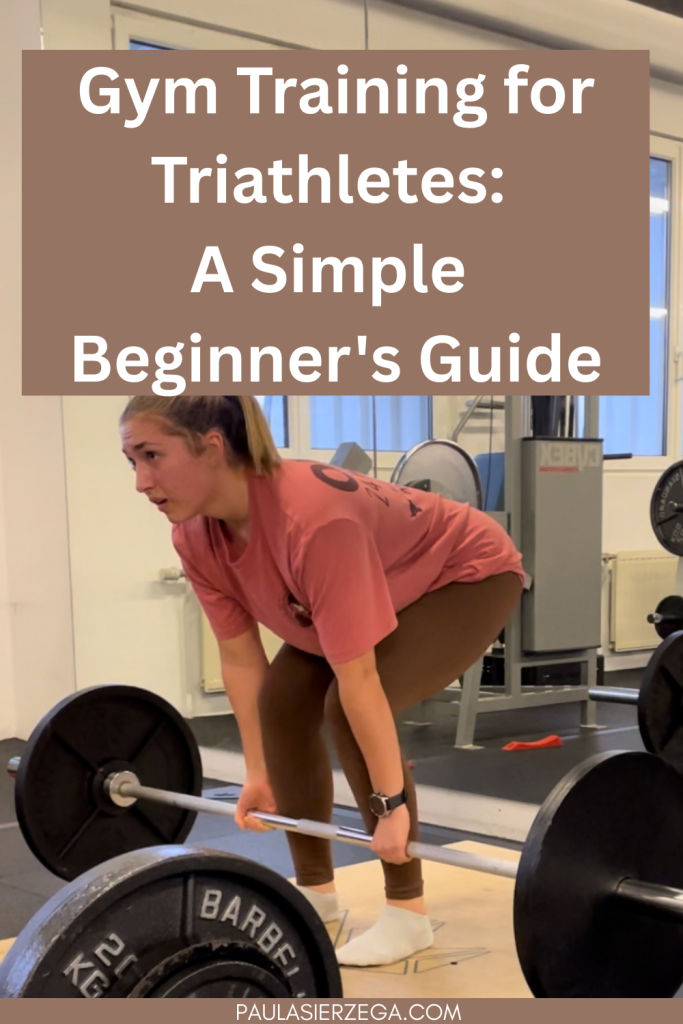
2. Hip Hinge
Examples: Romanian deadlift, kettlebell deadlift, hip hinge with dumbbells
Why it matters:
- Posterior chain strength (glutes, hamstrings)
- Injury prevention for runners
- Power transfer on the bike
3. Push
Examples: push-ups, chest press, dumbbell bench press
Why it matters:
- Shoulder balance for swimming
- Upper-body strength without overload
4. Vertical Pull
Examples: lat pulldown, assisted pull-ups
Why it matters:
- Swim propulsion
- Shoulder health and posture
5. Horizontal Pull
Examples: seated row, dumbbell row
Why it matters:
- Upper-back strength
- Counteracts cycling posture
- Supports shoulder stability
6. Core (Anti-Movement)
Examples: planks, dead bugs, Pallof press
Why it matters:
- Force transfer between upper and lower body
- Running efficiency
- Injury prevention
If your gym program covers these patterns consistently, you’re already doing enough.
How to Choose the Right Weight (Beginner Rule)
This is where many triathletes go wrong.
They either:
- lift far too heavy, sacrificing technique
- or go far too light, doing endless reps with no stimulus
Simple Weight Selection Rule
Choose a weight you can lift:
- for 8–12 controlled reps
- with 2–3 reps left in reserve
- while maintaining perfect technique
If your form breaks down, the weight is too heavy.
If you finish and feel nothing, it’s too light.
Strength gains come from consistent, controlled loading, not from chasing exhaustion or numbers.
A good rule of thumb: you should finish a set feeling like you could do more, but choosing not to.
Common Beginner Mistakes to Avoid
1. Copying Bodybuilders
Triathletes don’t need:
- isolation-only workouts
- high-volume split routines
- training to failure every set
Those methods are designed for muscle hypertrophy (increasing muscle size), not endurance performance or injury prevention.
2. Doing Too Much Too Soon
More soreness does not mean better results.
Start with:
- 1–2 sessions per week
- low to moderate volume
- conservative loading
Your nervous system, tendons, and connective tissue need time to adapt, especially if strength training is new to you.
3. Skipping Warm-Ups
The warm-up isn’t optional.
A proper warm-up:
- increases range of motion
- improves coordination
- reduces injury risk
It doesn’t need to be long, but it should be intentional.
Think of it as a transition from endurance mode to strength mode.
A Very Simple Gym Plan for Triathletes (30–40 Minutes)
This plan is not meant to be fancy.
It’s meant to be:
- repeatable
- sustainable
- effective
Warm-Up (5-10 Minutes)
- 5-10 minutes easy bike, rower, or treadmill
- Followed by dynamic mobility. For example:
- leg swings
- arm circles
- bodyweight squats
The goal is to feel warmed up, not tired.
Main Workout (25–30 Minutes)
Perform 2–3 sets of each exercise:
- Lunges or Squats – 8–10 reps
- Romanian Deadlift – 8–10 reps
- Lat Pulldown – 8–12 reps
- Seated Row – 8– 12 reps
- Push-Ups or Chest Press – 8–12 reps
- Plank or Dead Bug – 30–45 seconds
Rest: 90–180 seconds between sets.
That’s it.
You don’t need more as a beginner. Consistency beats complexity.
Cool Down (5 Minutes)
- Light stretching only (no aggressive stretching after strength work)
- Breathing to downregulate your nervous system
Slow nasal breathing helps shift your body out of “training mode” and supports recovery.
How This Fits Into Your Triathlon Training
Strength training should support your swim, bike, and run, not compete with it.
Early on:
- keep loads moderate
- focus on technique
- stay consistent
As you progress, you can:
- increase resistance gradually
- add single-leg variations
- adjust volume seasonally
As race day approaches, strength training usually becomes less frequent and less demanding, while still maintaining key movement patterns.
Wrapping Up
You don’t need to:
- know every exercise
- lift heavy
- feel destroyed after each session
You need:
- basic movement patterns
- simple structure
- patience
The gym stops being intimidating once you realize it’s just another training tool, like the pool or the bike.
Start simple.
Stay consistent.
Build from there.
If you want help with planning your training, jump on a free 1:1 call with me.
More about Starting with Triathlon
- How to Get Started with Triathlon (As a Complete Beginner)
- How to Choose a Triathlon: A Step-by-Step Guide
- How to Set Triathlon Goals and Crush Your Next Race
- Mistakes To Avoid While Training For Your First Triathlon
- 50 Triathlon Essentials ALL Beginner Triathletes Need
- How To Make Indoor Triathlon Training Fun (10 Tips)
- 16 Powerful Cycling Tips for Triathletes
